The Missionary’s Adventure
April 2026
1 | Contrast
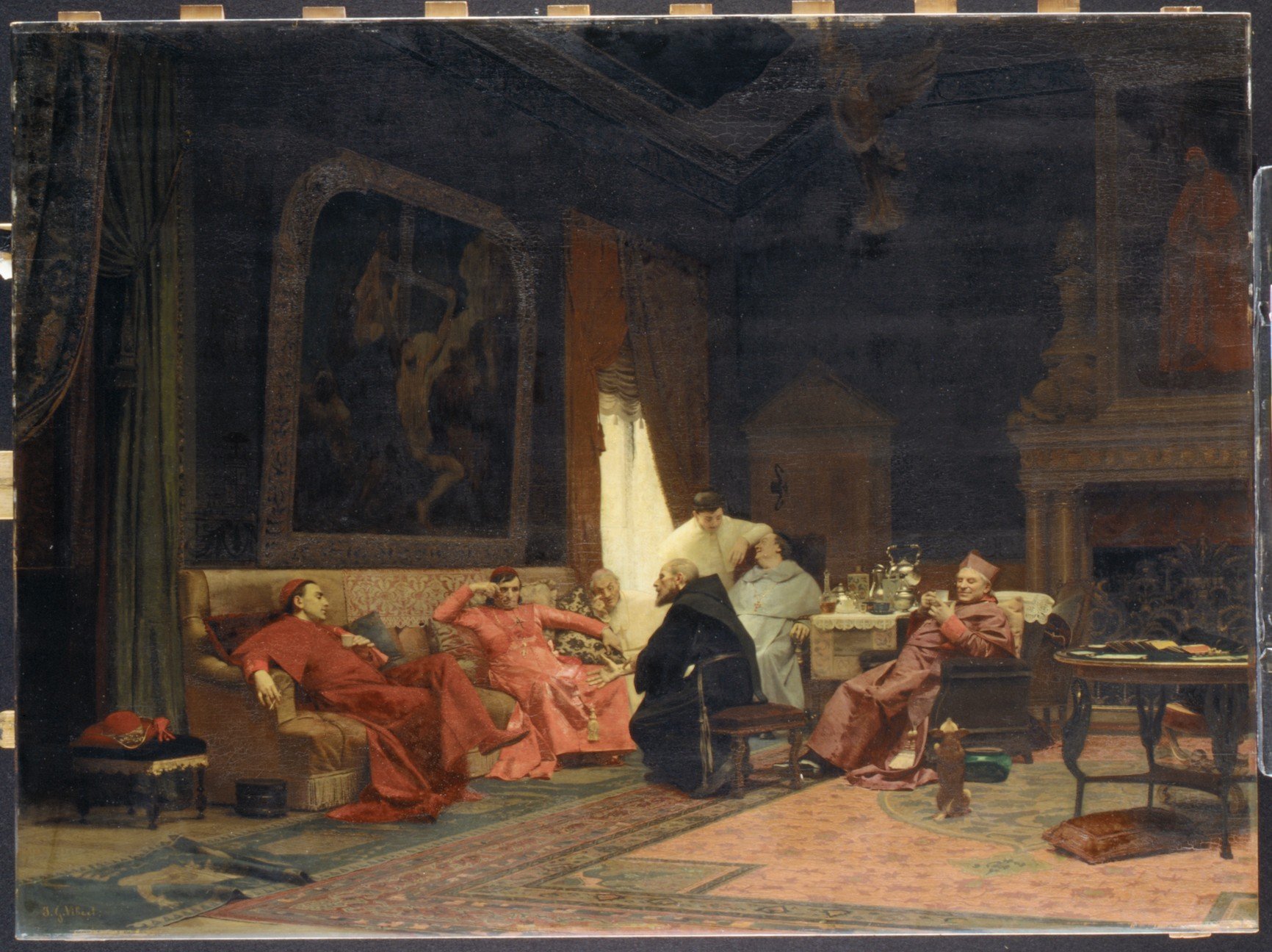
This is one of my favorite paintings, by Jean-Georges Vibert from the late 1800s. In it, a humble missionary just back from the field stands before a room of seated clerics, covered in robes and rings. He is telling them what happened, rolling up his sleeve, pointing to his scars and the cost of the journey. They look variously curious, bored, indulgent, as they sit under a painting of a martyrdom from a previous era of the church.
Vibert called the painting The Missionary's Adventure.
He did not call it The Missionary's Report, or The Missionary's Ministry. He called it adventure, from the Latin adventura: "the things that are about to happen." To “venture” is to go forward into what cannot be predicted, with faith-filled risk and the real possibility of loss or an uncertain return.
This painting centers a contrast, spotlighting the humble missionary, who has paradoxically changed the world and renewed the church in every era of history through his sacrifice, from the monastics to the Franciscans to the Wesleyans and the Jesus people. He carries the true spirit of adventure, in prophetic contrast to the institutions that have forgotten it.
This spirit of adventure is the spark that remakes the world. It's the posture that leads to renewal, movements, creativity, innovation, and courageous witness.
2 | Counterfeits
But the true spirit of adventure is costly, and so we have counterfeits. Adventure-alternatives wear the missionary's clothes and borrow his language, but have lost his simplicity, courage, and zeal.
No adventure. The first counterfeit is the spirit refused. The comfortable, institutional, opulent clerics, guarded by buildings their predecessors built when they were the pioneers. The institution does not actively oppose the missionary; it receives his report and returns to its agenda. It has too much to manage to be moved. Managing the institution is the work of the elite center, who can’t be overly bothered with what’s really happening on the edges.
Selfish adventure. The second is the spirit of adventure captured for the self. The traveler chasing fulfillment, the entrepreneur hoping to build a unicorn, and the personal-brand celebrity selling adventure as content. Modern culture stripped ventures of their deeper meaning and rebuilt them around return on capital. The aesthetic is daring, but the orientation is the self. We rarely stop long enough to ask, who is this really for. Adventure for the self is recreation or theater, at best.
Shallow adventure. The third is the spirit going shallow, naive, or thin. This is the well-meaning Westerner whose helping hurts those they went to help. This is the mission trip that never touches the people it floats above, and pretends it was transformational. The naive adventurer always keeps their journey short and sweet. Perhaps it plants the seeds of a deeper journey for some, but this is adventure as episodic experience, not as a true way of life.
The missionary adventure is none of these. It's deeper, in a few really important ways:
Its grounding is God. The missionary does not invent his going. He receives it. The pattern of God is sending. The Father sends the Son, who sends the Spirit, who sends the church. The missionary's adventure is participation in the Missio Dei, the love of God that takes risk and moves out into the world. This movement is what the institution has lost and what the entrepreneur never had.
Its motive is love. Love is the constraining force Paul named: the love of Christ compels us. The missionary goes because something has happened to him that requires him to go. Love is what distinguishes adventure from selfishness, even when both are willing to suffer. The selfish adventurer suffers for what he wants. The missionary suffers for whom he loves. Mission has a for whom as its deepest center.
Its goal is the frontier. The goal is the far edge, where the Gospel has not yet been. Paul's vision was for Spain, the edge of the known world. Each of Jesus' disciples ended on the frontiers of the empire. And there are frontiers today, like the 3 billion people with no meaningful access, the post-Christian neighbors in the west, or the refugees and immigrants in a new context, or the digital worlds of the next generation. The frontier is what makes the missionary in the deepest sense, and the frontier is what gives shape to the wineskins and communities that are needed for the Gospel. But the frontier takes sacrifice and perseverance, and doesn't yield easily.
Where these come together in the heart of a person or a community, the in-breaking of the Kingdom is already present. The spirit of adventure is how the love of God reaches the place it hasn't been yet.
3 | Community
But there is one flaw. The missionary in the painting stands by himself before the room, alone, with no friends by his side. I think this is a diagnosis, not a prescription. History shows us that the Gospel doesn't move through solitary heroes, but through committed fellowships, companies, friendships, movements, and societies.
The work of our time is not simply to send more heroic adventurers, but to cultivate new societies and communities that carry a shared imagination for the frontiers, together.
As Elton Trueblood said,
Whatever else may be the character of the redemptive society which the crisis of our time demands, it is at least clear that the society must make the habit of adventure central to its life.
The "missionary societies" needed for the frontiers of our time need to cultivate the habit of adventure again, lest we find ourselves on the couch in our clerical robes.